
How to Evaluate a RAG System Before Launch
A practical evaluation framework for retrieval augmented generation systems, covering test questions, retrieval quality, citations, failure modes, and release gates.
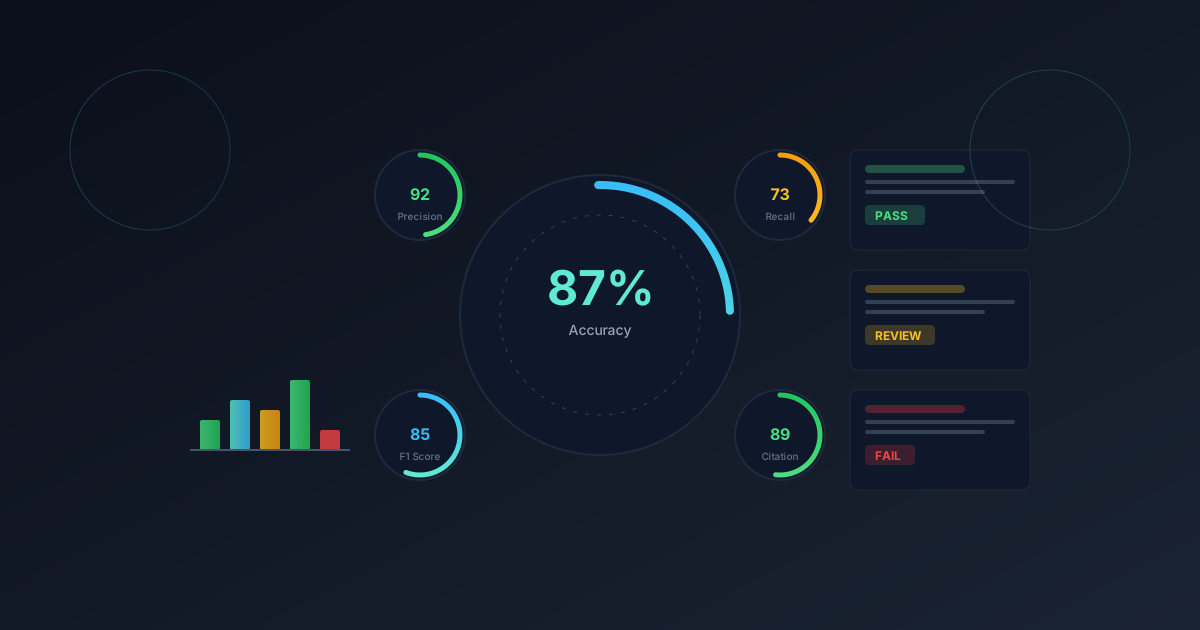
A RAG system can look impressive in a demo and still fail in production. The model may write fluent answers, but if retrieval finds the wrong source, the final answer is still wrong. That is why RAG evaluation must inspect both retrieval and generation before launch.
The goal is not to prove perfection. The goal is to know where the system works, where it fails, and what should happen when confidence is low.
Build a real question set
Start with questions actual users would ask. Pull from support tickets, sales calls, internal chat, search logs, onboarding sessions, and subject-matter experts. Include easy, common questions and difficult edge cases.
A useful evaluation set should include:
- Questions with one clear answer.
- Questions that require multiple sources.
- Questions with outdated or conflicting sources.
- Questions where the correct behavior is "I do not know."
- Questions that test permissions.
- Questions that use informal user language.
Do not rely only on synthetic questions written by the implementation team. They tend to match the system's assumptions too closely.
Evaluate retrieval separately
Before judging the final answer, inspect whether the retriever found the right evidence. If the correct source is missing from the retrieved context, the generation step is already compromised.
Useful retrieval metrics include recall at k, precision at k, source freshness, citation coverage, and whether the top result is the source a human expert would choose. You do not need a complicated benchmark to start. A spreadsheet with questions, expected sources, retrieved sources, and reviewer notes is often enough for the first pass.
This step helps teams find chunking problems, weak metadata, missing documents, stale sources, and poor ranking.
Evaluate the answer against the evidence
Once retrieval is acceptable, evaluate generated answers. Reviewers should check whether the answer is correct, complete, grounded in the retrieved sources, appropriately cautious, and useful to the user.
A simple rubric can work:
- Correct: the answer matches approved sources.
- Grounded: every important claim is supported by retrieved context.
- Complete: the answer covers the user's actual question.
- Clear: the answer is easy to understand.
- Safe: the answer follows escalation and refusal rules.
Track failure reasons. "Wrong answer" is less useful than "correct document not retrieved" or "model ignored escalation rule."
Test citation behavior
Citations are a core production feature for many RAG systems. They help users verify answers and help reviewers debug failures.
Check whether citations point to the exact source used, whether they are visible in the UI, and whether the system avoids citing sources that do not support the claim. A citation that merely points somewhere in the knowledge base is not enough.
Include negative tests
A launch-ready system should handle unknowns. Add questions that should not be answered because the source is missing, the user lacks permission, or the request falls outside scope.
The expected behavior may be a refusal, a clarification question, or a handoff to a human. Whatever it is, define it before evaluation. Otherwise the model will be rewarded for guessing.
Create release gates
Before launch, set minimum thresholds. For example:
- At least 90% of priority questions retrieve the expected source.
- No critical policy answers without citations.
- No answers for permission-denied sources.
- Escalation triggers work for defined risk categories.
- Reviewers approve a target percentage of answers in the pilot workflow.
The exact numbers depend on the use case. The point is to decide what is good enough before the system is under pressure.
Keep evaluation running after launch
RAG systems change as documents, users, and workflows change. Evaluation should be part of operations, not a one-time checklist. Add new failed questions to the test set, track regressions, and review retrieval quality when sources are added.
This is how a RAG system stays useful after the initial release.
Inferencia builds retrieval systems with evaluation pipelines, citations, and failure handling from the start. Learn more about our production AI process or contact us.