
Document Intelligence Pipelines: From Extraction to Human Review
A production-oriented guide to document intelligence pipelines that extract, classify, summarize, route, and review high-volume business documents.
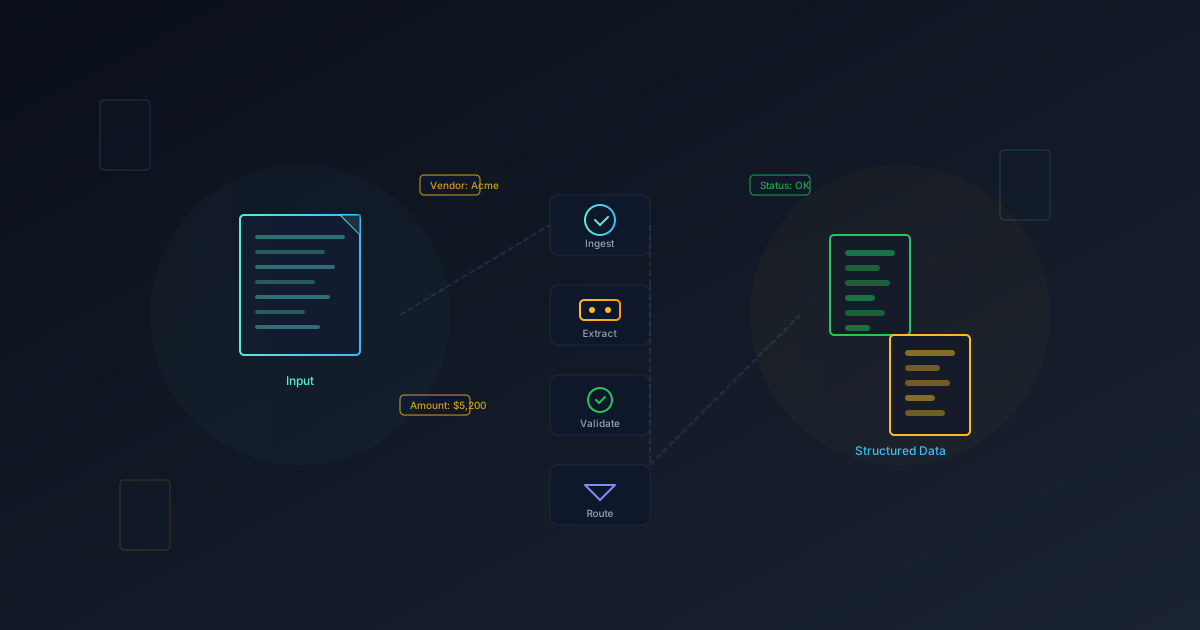
Document intelligence is not just OCR plus a summary. In production, documents need to be received, classified, extracted, validated, routed, reviewed, and monitored. The pipeline matters as much as the model.
The best systems are designed around the business decision the document supports. A contract, claim form, invoice, onboarding packet, or compliance report is useful only when the right information reaches the right workflow with enough confidence.
Define the document job
Start by naming what the document pipeline must do. Common jobs include extracting fields, classifying document type, summarizing important clauses, detecting missing information, comparing values against a system of record, or routing the document to a queue.
A vague goal like "understand documents" is hard to build and impossible to measure. A specific goal like "extract vendor, invoice number, due date, total, tax amount, and purchase order, then flag mismatches for review" is buildable.
Separate extraction from judgment
Many pipelines mix extraction and decision-making too early. It is better to separate stages:
- Ingest the document.
- Identify type and layout.
- Extract structured fields.
- Validate fields against rules or databases.
- Summarize or classify if needed.
- Route to automation or human review.
This makes errors easier to diagnose. If a value is wrong, you can tell whether the OCR failed, the extraction prompt failed, the validation rule was missing, or the routing decision was incorrect.
Use confidence and validation
Production document systems should not treat every output equally. Some fields are easy to extract. Others require interpretation. Use confidence signals, schema validation, required field checks, and cross-checks against existing records.
For example, an invoice total can be compared to line items, a customer name can be matched against CRM records, and a contract date can be checked for valid format. AI output should be treated as a candidate result until it passes validation or receives human approval.
Design human review intentionally
Human review should not be a dumping ground for every uncertain document. Reviewers need the original document, extracted fields, highlighted evidence, validation errors, and a clear approval path.
Good review interfaces reduce cognitive load. They show what changed, why the system is uncertain, and which fields need attention. They also capture corrections so the pipeline can improve.
Monitor failure patterns
Document pipelines fail in patterns: rotated scans, low-quality images, unusual layouts, missing pages, handwritten fields, duplicate submissions, unsupported languages, and ambiguous clauses.
Track these patterns from the start. The team should know which document types require manual review, which sources produce low-quality scans, and which fields have the highest error rate. That information informs both model improvements and process changes upstream.
Start with a narrow document set
The fastest way to build trust is to start with one document family and one business outcome. For example, automate first-pass extraction for one invoice type or one onboarding packet. Once that works, expand to adjacent types.
Trying to handle every document format immediately leads to a brittle system with unclear quality.
What production readiness looks like
A production document intelligence pipeline should have typed outputs, validation rules, human review, audit logs, retry handling, failure queues, source retention policy, and measurement. It should also make it easy to add examples and improve over time.
When built this way, document intelligence can remove hours of repetitive review while preserving the controls operations teams need.
Inferencia builds document pipelines for extraction, summarization, classification, and human review workflows. Explore our workflow automation work or reach out.